Leading international healthcare and improving the quality of life for domestic pediatric patients with rare diseases through research-based diagnosis and treatment
Rare Disease Specialized Center Operation Program
The Korea Disease Control and Prevention Agency (KDCA) newly designated 17 regional Rare Disease Specialized Centers nationwide in 2024 to strengthen the support system for rare disease care and to promote the National Rare Disease Registry program.
Under Article 14 of the Rare Disease Management Act, a Rare Disease Specialized Center is a medical institution that carries out clinical care, research, and registry and statistical activities for patients with rare diseases.
Regional Rare Disease Specialized Centers provide specialized medical services for the diagnosis, treatment, and management of rare disease patients. They establish cooperative networks with regional medical institutions to improve patients’ access to healthcare. In addition, these centers build and operate databases for the registration and systematic management of rare disease patients.
Rare Disease Registry and Statistics
Collection of rare disease statistical data for the production of national statistics
Clinical Care and Patient Support
Operation of specialized clinics and multidisciplinary teams, and linkage to patient support programs
Education Support
Provision of education to strengthen the capacity of specialized professionals, and delivery of up-to-date medical knowledge to patients and caregivers
Awareness Raising
Public outreach activities to improve awareness of rare diseases, and surveys conducted to collect baseline information on influencing factors
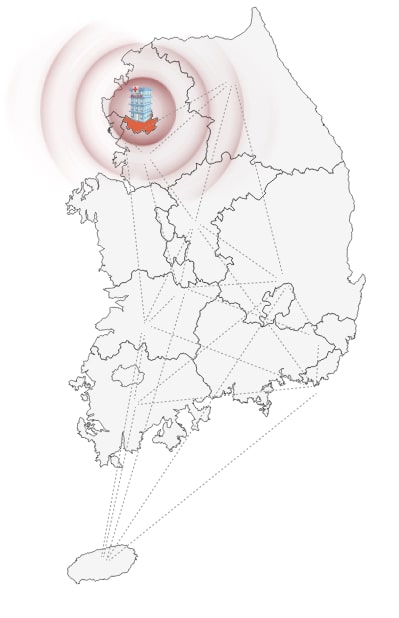
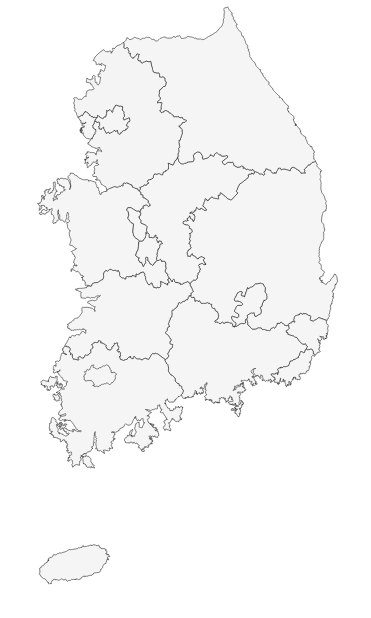
Visualization of Rare Disease Regional Hub Centers
Rare Disease center Seoul National University Hospital
Gangwon Regional Hub Center Wonju Severance Christian Hospital
Northwestern Gyeonggi Regional Hub Center Inha University Hospital
Southern Gyeonggi Regional Hub Center Ajou University Hospital
Chungbuk Regional Hub Center Chungbuk National University Hospital
Daegu, Gyeongbuk Regional Hub Center Chilgok Kyungpook National University Hospital
Chungnam Regional Hub Center Chungnam National University Hospital
Jeonbuk Regional Hub Center Jeonbuk National University Hospital
Ulsan · Gyeongnam Regional Hub Center Yangsan Pusan University Hospital
Busan Regional Hub Center Inje University Busan Paik Hospital
Jeonnam Regional Hub Center Hwasun Chonnam National University Hospital
Jeju Regional Hub Center Jeju National Hospital
Rare Disease Registry and Statistics
Collection and submission of statistical data to produce effective national statistics through management and analysis of medical institution–based registry data
Development of disease-specific databases, analysis of healthcare utilization and medical workforce status, and establishment of data system integration and utilization strategies
Clinical Care and Patient Support
Operation of specialized clinics for rare disease care and multidisciplinary teams for comprehensive diagnosis
Provision of tailored genetic counseling for patients requiring genetic consultation, using medical orders and counseling records
Linkage of newly diagnosed rare disease patients to various support programs
Education Support for Healthcare Professionals, Rare Disease Patients and Caregivers, and the General Public
Systematic collection of medically and socially underserved rare disease information and provision of accurate disease information to the public
Delivery of up-to-date medical knowledge through non-face-to-face online lectures and provision of medical education and emotional support through in-person programs
Provision of capacity-building education for healthcare professionals and establishment of platforms for treatment information exchange
Other Activities
Surveys to collect baseline information on user satisfaction with Rare Disease Specialized Centers and related influencing factors
Outreach activities for disease information provision and rare disease awareness improvement
4 Types of Project Objectives
Establishing infrastructure for genomic research on rare pediatric diseases & identifying/diagnosing newly discovered undiagnosed diseases/disorders
Discovering and applying therapeutic substance for rare diseases through mechanism research linked to basic life sciences
Leading the future of healthcare by building & sharing standardized clinical genomic databases
Training experts in the field of rare pediatric diseases
In 2021, the family of the late Samsung Chairman Mr. Lee Kun-hee donated to the Seoul National University Children’s Hospital for the purpose of overcoming childhood cancer and rare diseases. To uphold our donors’ noble intention, Seoul National University Hospital launched the Lee Kun-hee Childhood Cancer & Rare Disease Project.
The project funds allow us to analyze entire genomes of the child patients with rare diseases that have not been diagnosed by conventional testing methods, as well as the genomes of their parents. This is done by performing trio based whole exome sequencing (WES) on the blood samples collected from the patients and their parents and analyzing the results. The project enables us to actively seek the causative gene to help diagnose the patient, study the function of the gene, and thereby laying the foundation for future treatment. In addition, the project also helps patients with non-genetic diseases that cannot be diagnosed with common tests due to the rarity of their conditions by conducting patient-specific tests to diagnose and suggest treatment and management.
Participating Hospitals
Kangwon National University Hospital
EWHA Womans University Mokdong Hospital
SAMSUNG Medical Center
Seoul National University Hospital
Seoul National University Bundang Hospital
Korea University Ansan Hospital
Hallym University Dongtan Sacred Heart Hospital
Chungbuk National University Hospital
Chungnam National University Hospital
Chonnam National University Hospital
Kyungpook National University Hospital
Inje University Busan Paik Hospital
Yangsan Pusan University Hospital
SAMSUNG Changwon Hospital
Pusan National University Hospital
Jeju National Hospital
의료기관 기반의 등록 자료 관리·분석을 통해 실효성 있는 국가 통계 생산을 위한 통계 자료 수집 및 제출